Electrical Signal Testing
Optical Transmission Performance Testing
Automated Optical Communication Test Equipment
Fiber End-Face Physical Characteristics Testing
Fiber End-Face Cleaning
 Trace signals to their source and precisely analyze electrical signal transmission characteristics. SignalLab, a sub-brand of Dimension Technology, specializes in electrical signal quality and transmission performance testing and analysis. Its product portfolio includes bit error rate testers (BERTs), clock recovery instruments, and other test equipment.
Recommended
65 GHz Optical Sampling Oscilloscope
NEW2026.11
 Reveal the true parameters of optical performance. ReveLuX, a sub-brand of Dimension Technology, specializes in optical performance measurement and analysis. Its product portfolio includes insertion loss and return loss testers, optical time-domain reflectometers (OTDRs), optical power meters, and other test instruments.
Recommended
FA MAX 3 Polarity and IRL Meter
NEW2026.10
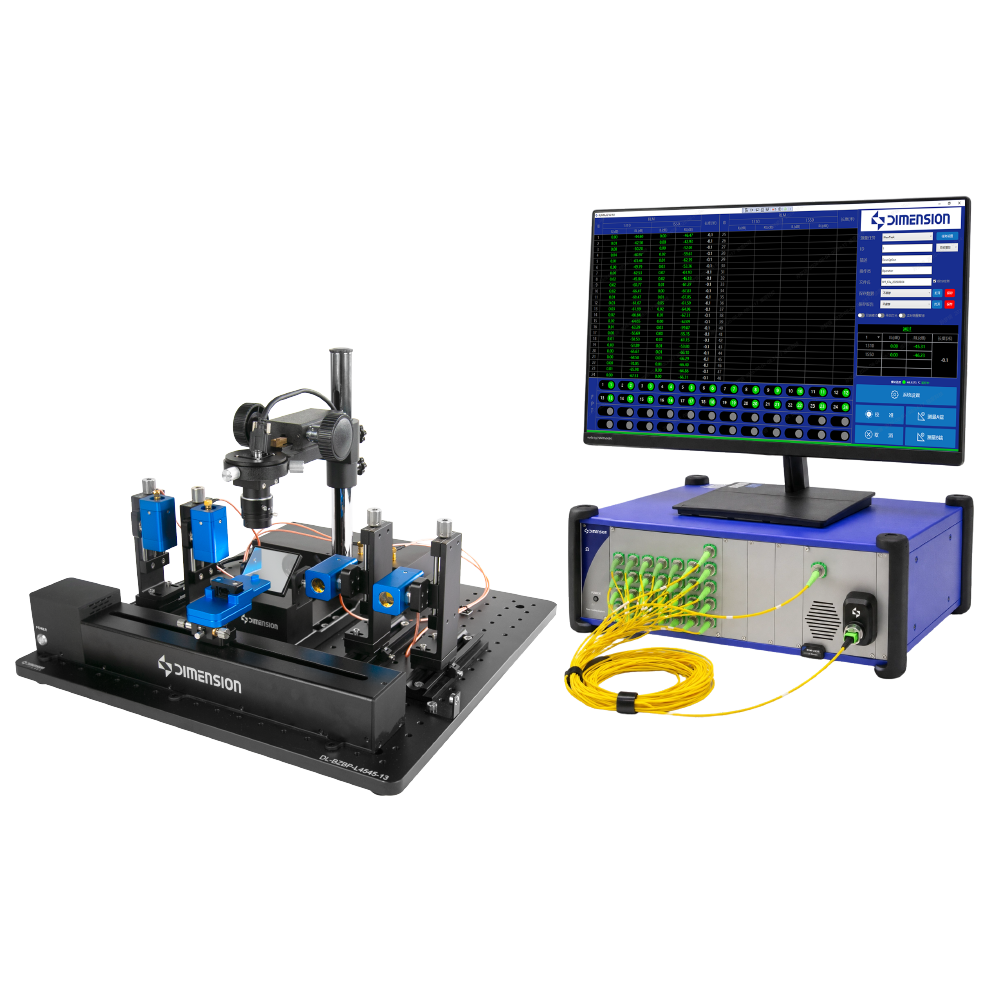
 Specializing in automated testing, inspection, and screening, VeriAuto is Dimension Technology's sub-brand dedicated to intelligent automated test equipment. Its product portfolio includes automated fiber end-face inspection, cleaning, and optical coupling equipment.
Automated Fiber End-Face Cleaning and Inspection Systems
Automated Cleaning and Inspection Equipment for CPO Optical Source Modules(New)
Automated Cleaning and Inspection Equipment for NPO/XPO Optical Modules(New)
Automated Cleaning and Inspection Equipment for 1.6T MPO Optical Transceivers(New)
Fully Automated Cleaning and Inspection System for 1.6T/800G Optical Transceivers
800G LC Intelligent End-Face Cleaning and Inspection System
Automated Optical Coupling Systems
Fully Automated High-Precision Microlens Array Coupling for CPO and High-Speed Optical Transceivers(New)
High-speed optical module and all-in-one automatic high-precision coupling equipment for silicon photonics FA
Fully Automated High-Precision Lens Module Coupling Equipment for High-Speed Optical Transceivers
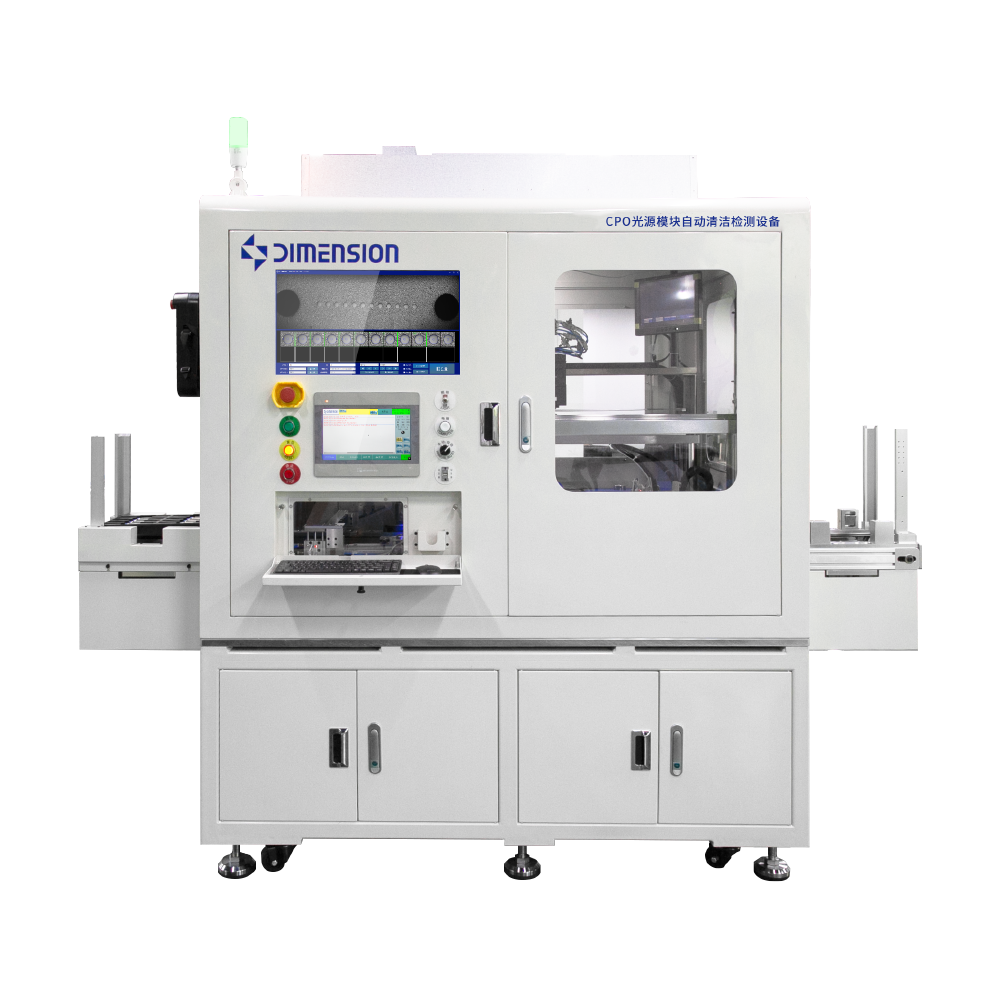
 Precisely revealing the physical characteristics of fiber end faces. EndFace is Dimension Technology's sub-brand specializing in the inspection and analysis of fiber end-face physical characteristics. Its product portfolio includes fiber end-face inspection instruments, interferometers, and fiber core pitch measurement instruments.
Intelligent Fiber End-Face Inspection Systems
SmartCheck FV Full-Field Fiber End-Face Inspector(New)
Fast Check MT Fully Fiber Endface Inspector
SmartCheck Intelligent Fiber Endface Inspector
FastCheck Pro Fully Automatic Fiber Endface Inspector
EasyCheck V2 Integrated Fiber Endface Inspector
EasyCheck V3 Integrated Fiber Endface Inspector
EasyCheck Dual Magnification Fiber Endface Inspector
FA-1 Fiber Array End-Face Inspector
Recommended
MT SCOPE Fiber Endface Inspector
NEW2026.9
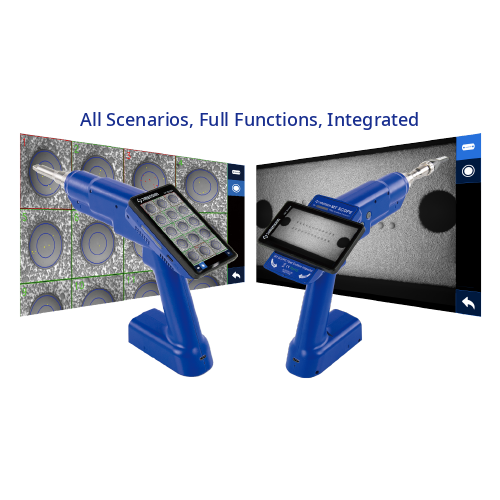
 Fast and effective cleaning of microscopic optical end faces. OffSoon is Dimension Technology's sub-brand specializing in cleaning fiber end faces and precision micro-optical components. Its product portfolio includes single-fiber and multi-fiber end-face cleaning machines, cleaning pens, and other cleaning products.
65 GHz Optical Sampling Oscilloscope NEW2026.11
65 GHz Optical Bandwidth | 1, 2, or 4 Channels | Transmitter Impairment Simulation | Up to 1 MSa/s Sampling Rate
65 GHz optical bandwidth to meet high-speed optical signal measurement requirements
Flexible 1-, 2-, and 4-channel configurations
Automatic measurement of key PAM4 optical signal parameters
Support for reference receiver filtering and TDECQ analysis
Save and quickly recall test configurations
Intuitive user interface for clear visualization of waveforms and measurement parameters
Product Details
Product Overview
Product Overview As data centers and high-speed optical interconnects evolve toward higher data rates, optical transceivers face increasingly stringent requirements for transmitter signal quality. Eye diagram degradation and waveform distortion have become critical challenges in R&D debugging and performance validation.
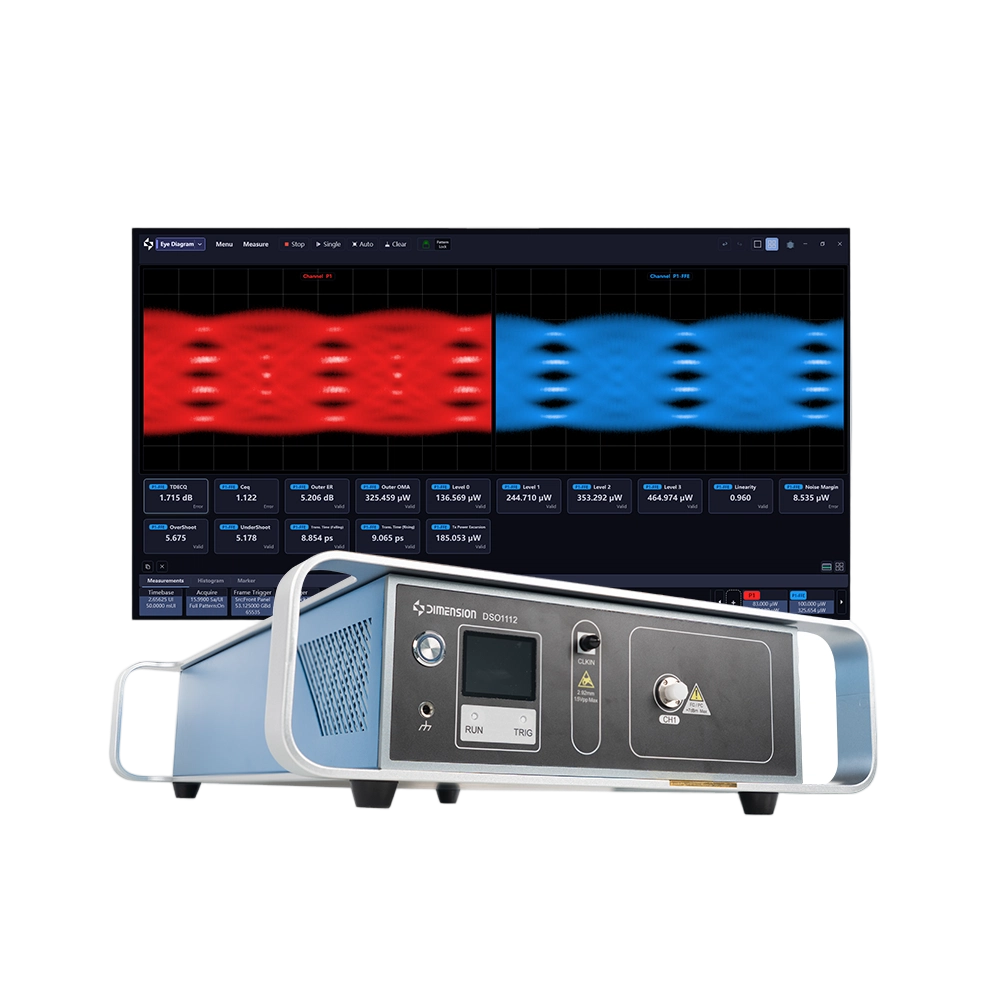
Dimension Technology introduces its 65 GHz Optical Sampling Oscilloscope, supporting NRZ and PAM4 eye diagram visualization and PAM4 parameter measurements. The instrument enables engineers to observe signal characteristics, evaluate the effects of parameter adjustments, and perform testing for the development, validation, and performance optimization of optical transceivers and optical transmitters.
Key Features
65 GHz optical bandwidth to meet high-speed optical signal measurement requirements
Flexible 1-, 2-, and 4-channel configurations
Automatic measurement of key PAM4 optical signal parameters
Support for reference receiver filtering and TDECQ analysis
Save and quickly recall test configurations
Intuitive user interface for clear visualization of waveforms and measurement parameters
Applications
High-speed optical transceiver R&D and performance validation
Optical transmitter debugging and performance evaluation
Signal quality analysis for data center optical interconnects
Optical transceiver production testing and quality screening
Optical signal quality evaluation during temperature and aging tests
High-speed optical communication research and laboratory education
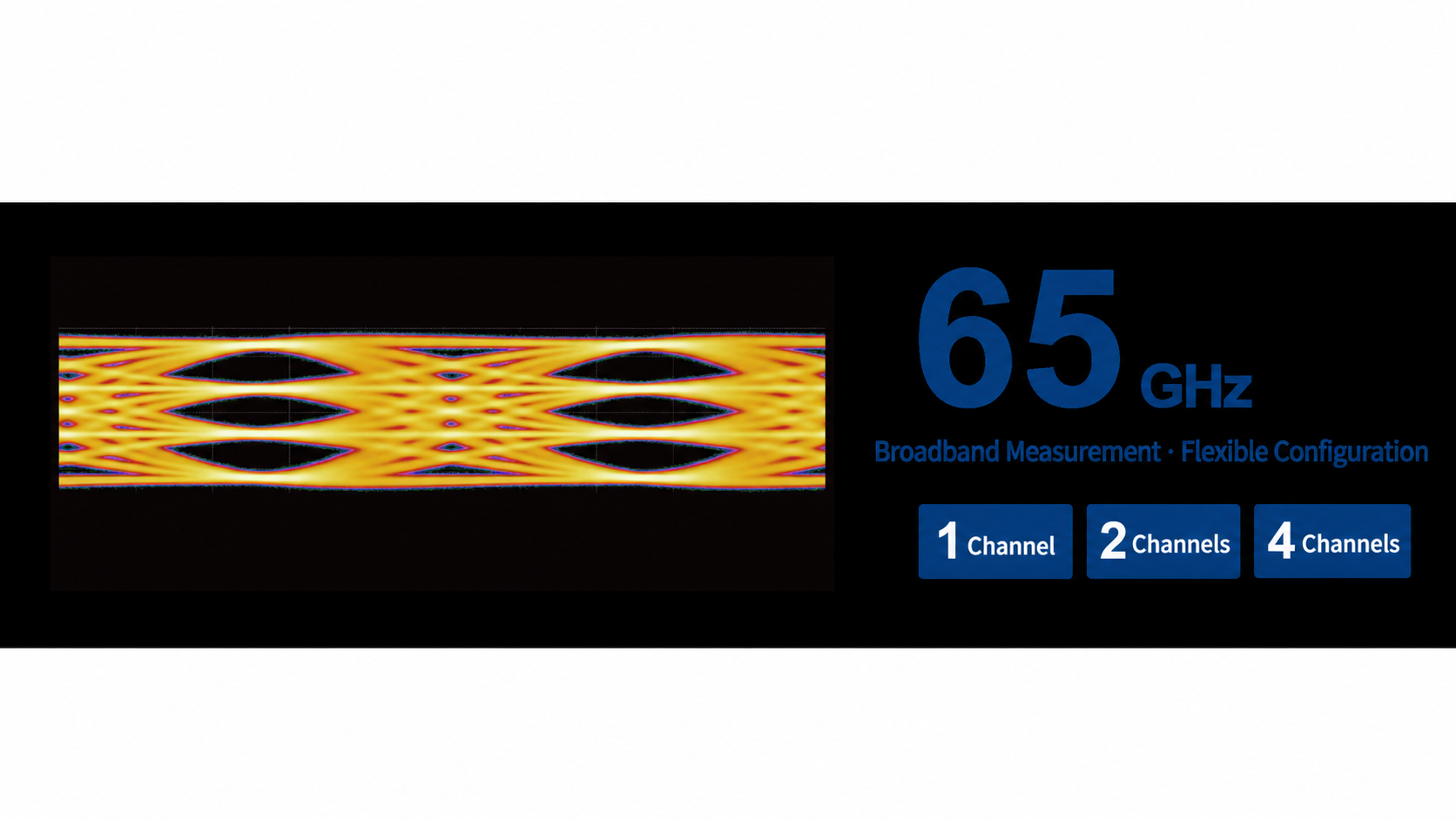
65 GHz Optical Bandwidth with Flexible 1-, 2-, and 4-Channel Configurations
Evaluating high-speed optical signals requires careful examination of eye opening, signal level distribution, and transition edges.
The Dimension Optical Sampling Oscilloscope provides 65 GHz optical input bandwidth, enabling detailed waveform observation and eye diagram analysis of high-speed optical signals.
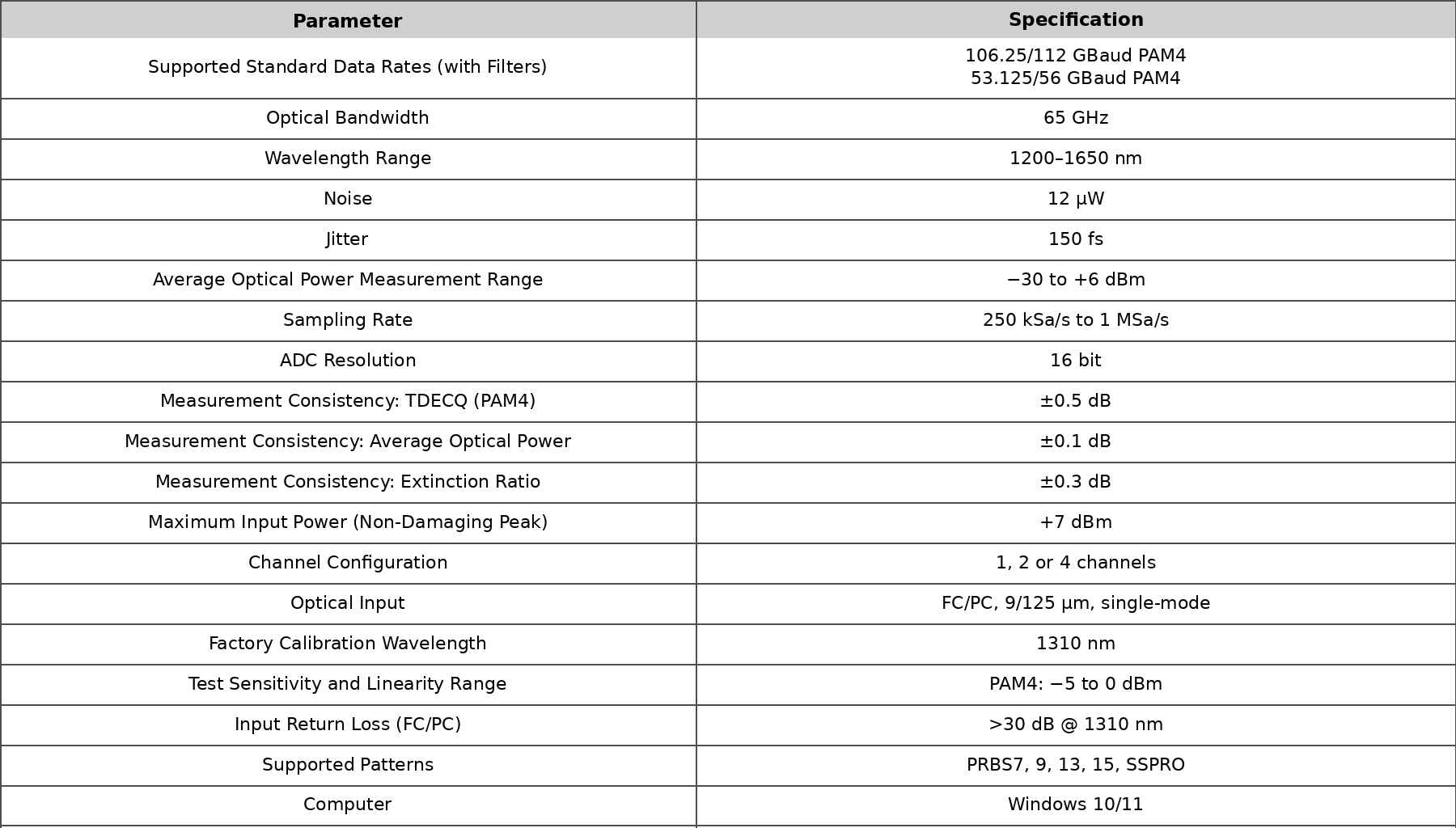
Combined with reference receiver filtering configurations for standard PAM4 symbol rates of 53.125/56 GBaud and 106.25/112 GBaud, the instrument supports transmitter signal measurements at different data rates. Engineers can use eye diagrams and measurement results to evaluate the effects of signal adjustments during debugging.
To accommodate different testing requirements, the instrument is available in 1-, 2-, and 4-channel configurations.
A single-channel configuration is suitable for individual device development and debugging. For applications requiring additional measurement channels, users can select dual-channel or four-channel configurations based on the number of devices under test, testing requirements, and budget.
These flexible configurations allow users to match bandwidth capabilities and channel capacity to their specific needs, supporting device debugging, sample evaluation, and multi-channel test platform development.
Transmitter Impairment Simulation
Transmitter debugging involves not only observing current signal behavior but also understanding how parameter changes affect signal quality.
The instrument supports transmitter impairment simulation, allowing users to configure simulation parameters and create different impairment conditions. Engineers can then observe changes in signal waveforms and eye diagrams, transforming abstract impairment effects into visible and comparable simulation results.
During R&D analysis, engineers can first establish reference conditions and then adjust selected simulation parameters to compare signal characteristics under different settings.
By systematically modifying parameters and observing the resulting changes, users can investigate the relationship between impairment factors and signal behavior. This provides useful insights for debugging, problem analysis, and test methodology validation.
Combining simulation analysis with actual signal measurements also helps engineers develop more targeted validation approaches.
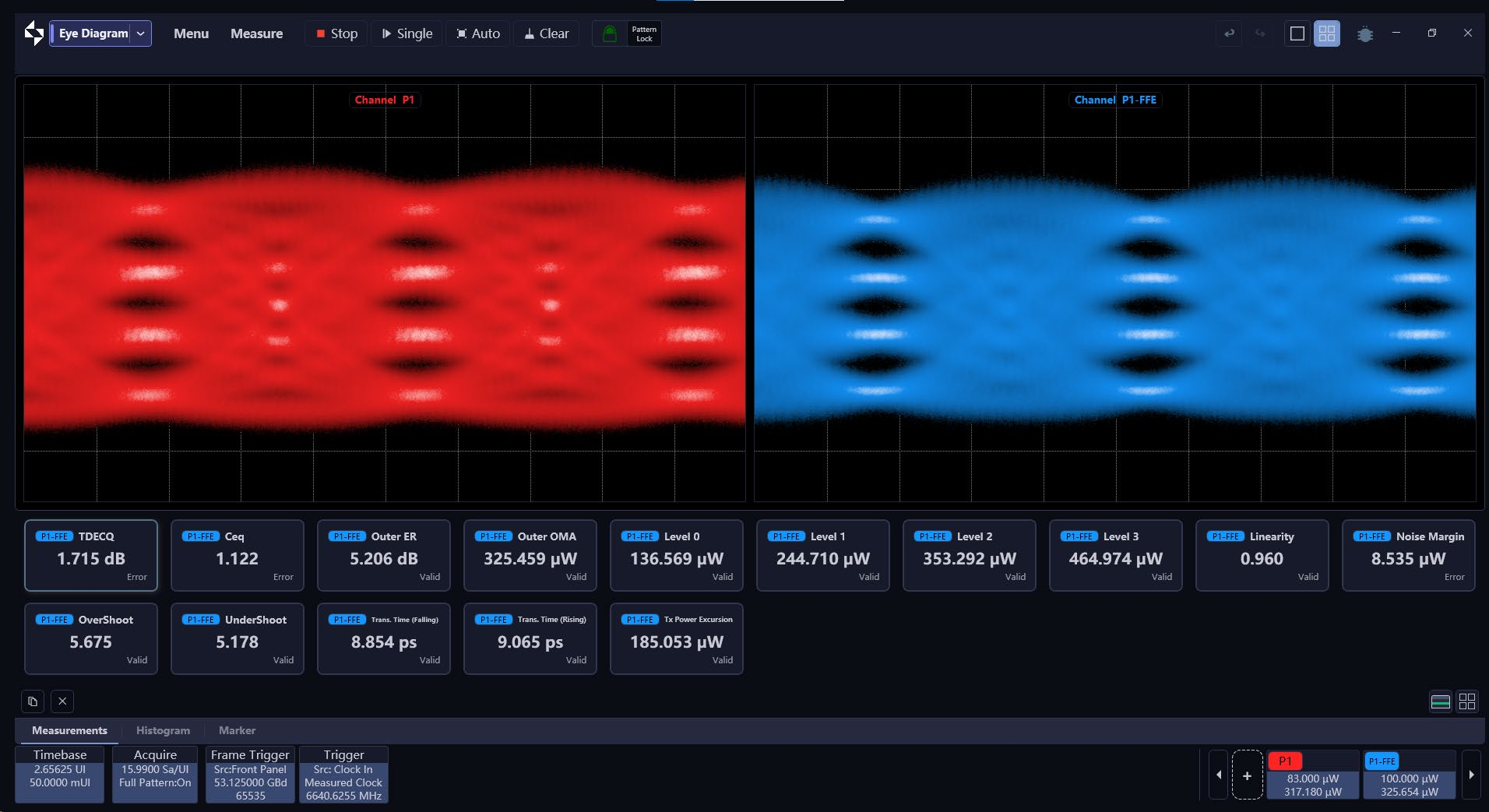
Analog Signal Measurement Diagram
Sampling Rate of Up to 1 MSa/s
Eye diagrams are formed by accumulating sampled data points, making acquisition efficiency an important factor in determining the time required to collect sufficient samples.
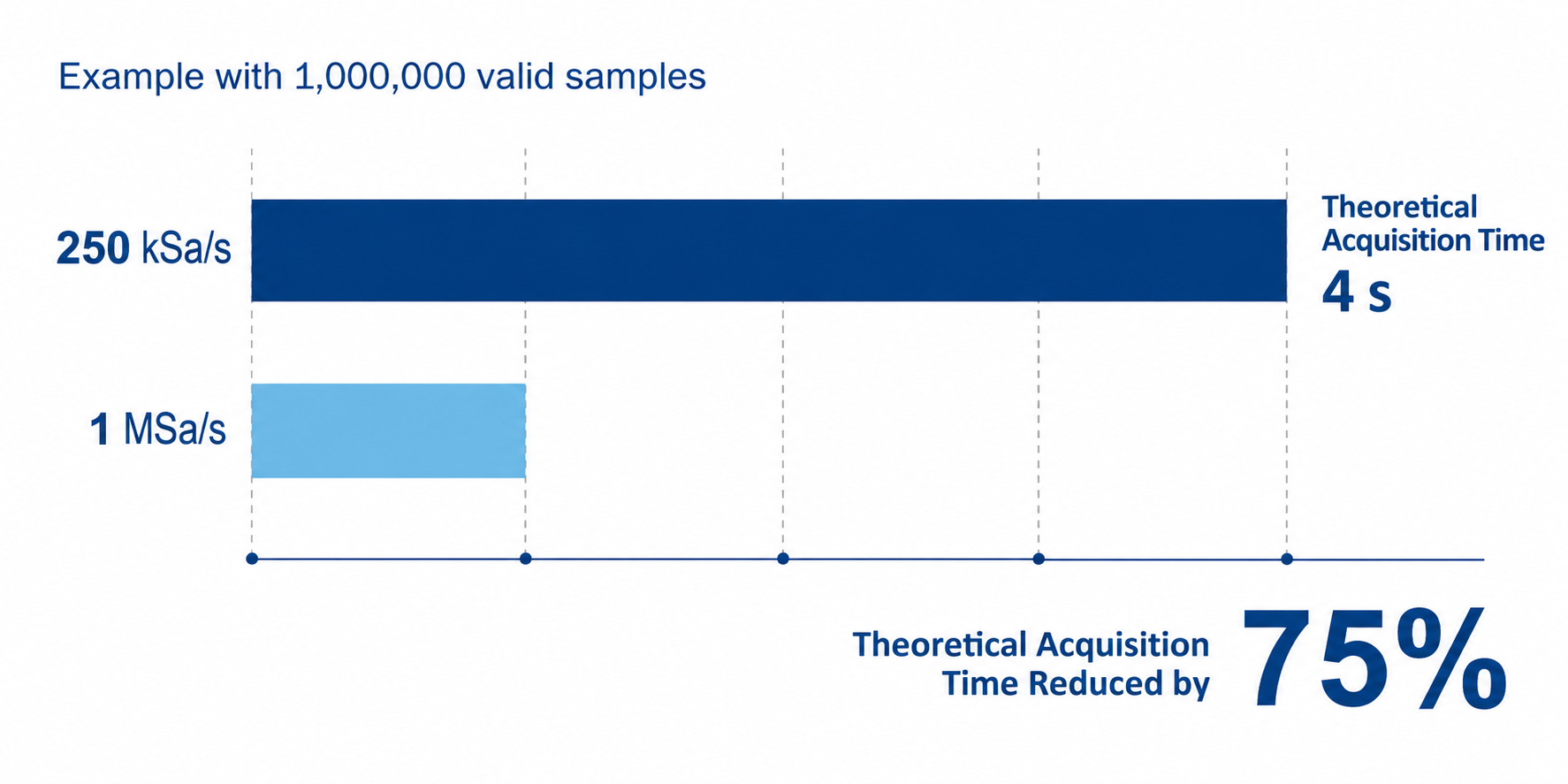
The instrument offers sampling rates ranging from 250 kSa/s to 1 MSa/s. Under applicable acquisition conditions, higher sampling rates enable faster accumulation of data for eye diagram observation and parameter analysis.
For R&D applications involving repeated configuration adjustments and measurement comparisons, faster sampling helps reduce acquisition waiting time, allowing engineers to proceed more efficiently to subsequent testing and validation steps.
For example, when acquiring 1 million valid samples, the theoretical acquisition times at sustained effective sampling rates of 250 kSa/s and 1 MSa/s are 4 seconds and 1 second, respectively.
This represents a 75% reduction in theoretical acquisition waiting time for the same sample count.
This advantage is particularly relevant to applications where sample accumulation efficiency is important. Actual total measurement time also depends on triggering and synchronization, data transfer, parameter calculations, and the selected test configuration.
Key PAM4 Parameter Measurements
Designed for high-speed optical transceiver transmitter testing, the instrument supports measurements of key PAM4 parameters, including optical power, optical modulation amplitude (OMA), extinction ratio, signal level distribution, and TDECQ.
These measurement capabilities allow engineers to evaluate PAM4 optical signals from multiple perspectives, including output power, modulation characteristics, and signal quality, providing quantitative data for R&D validation and production testing.
By combining eye diagram observation with parameter measurements, engineers can compare signal performance across different driver settings, operating conditions, and device samples.
The measurement results help assess how parameter adjustments affect transmitter performance and support the investigation of issues such as eye diagram degradation and signal level imbalance.
These capabilities provide testing support for device debugging, design optimization, and quality screening.
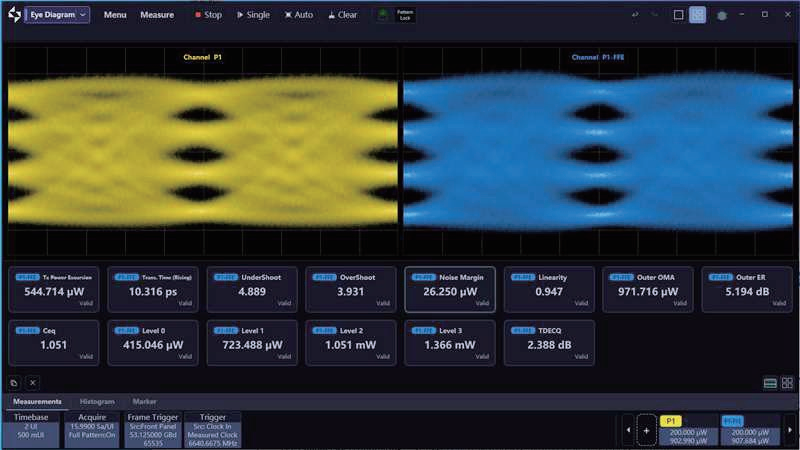
Actual Signal Measurement Diagram
Technical Specifications